


Corporate Bitcoin adoption is slowing in Q4 2025, with 65% of public companies now holding BTC below their purchase prices and facing unrealized losses. As the wave of corporate buying declines, Bitcoin miners are emerging as the most resilient accumulators.
This shift signals a new phase for corporate treasuries. Quarterly additions are on track for their lowest level in a year. Yet, miners continue to hold a central role in public-market BTC holdings, despite facing operational pressures and reduced profitability.
SponsoredCorporate Treasury Demand Dips as Market Volatility Grows
Bitcoin’s (BTC) November decline marked its steepest monthly drop so far this year. The largest cryptocurrency fell 17.67% over the month, pushing many 2025 buyers into the red.
Digital asset treasury firms were not immune. According to the November Corporate Bitcoin Adoption report from Bitcoin Treasuries, 65% of public companies with measurable cost bases acquired Bitcoin at prices higher than current market levels.
This has left these corporate treasuries holding unrealized losses. The estimate is based on data from a sample of 100 companies.
Meanwhile, demand has also cooled over the past few months. The report noted that public Bitcoin treasuries collectively acquired over 12,600 BTC in November. Major holders, including Strategy and Strive, accounted for the majority of net additions.
However, monthly disposals offset roughly 1,800 BTC of those purchases, bringing net additions down to approximately 10,800 BTC.
SponsoredSeveral firms reduced their Bitcoin exposure during November 2025. At least five companies reported net sales, driven by balance sheet management and strategic considerations:
- Sequans Communications sold nearly one-third of its Bitcoin reserves, liquidating approximately 970 BTC, valued at around $100 million, to reduce its convertible debt obligations.
- Kindly MD deployed 367 BTC into strategic investments, including stakes in Bitcoin-focused companies.
- Genius Group sold 62 BTC to strengthen its cash position for specific operational needs, and then repurchased 42 BTC in early December.
“Overall, while the ‘summer buying frenzy’ has clearly eased, demand has not vanished. Rather, public corporations appear to be normalizing to a slower, more selective cadence as they digest recent purchases and reassess risk,” Pete Rizzo wrote.
The report projects that Bitcoin additions in Q4 2025 will reach or slightly exceed 40,000 BTC by the end of December, making it the weakest quarter of the year and broadly aligning with accumulation levels last seen in Q3 2024.
Sponsored“This estimate is based on the past two months and the fact that Strategy has already added more than 10,000 BTC as of early December — putting Q4 buys within 5,000 BTC of the expected target as of Dec. 9.”
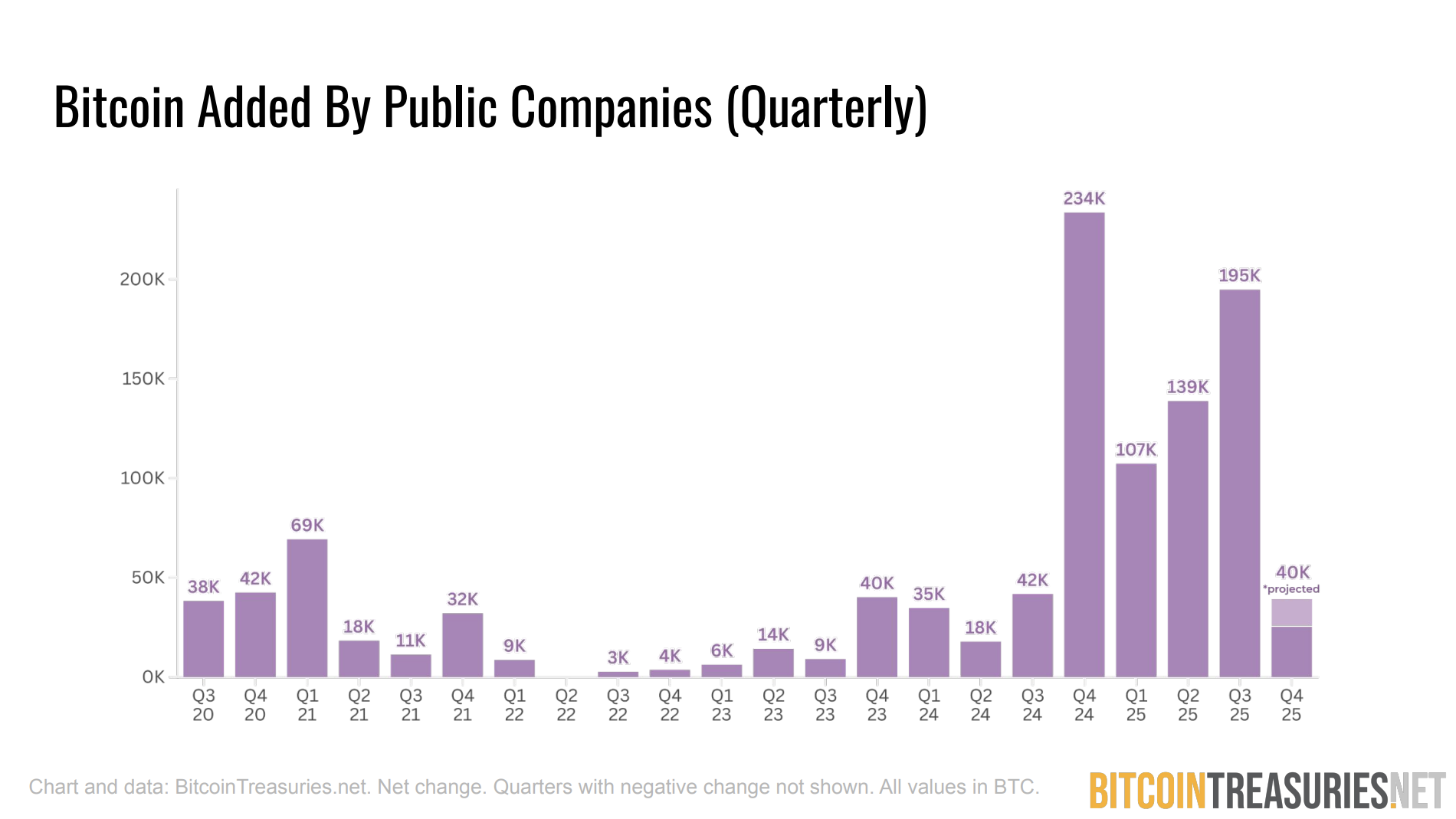
Miners Emerge as Strategic Corporate Accumulators
As treasury buying cools, Bitcoin miners could lead the next phase of corporate adoption. The report noted that mining companies anchor public-market BTC holdings. They accounted for about 5% of new additions in November and 12% of total public company BTC balances.
SponsoredIn that month, Cango and Riot added 508 and 37 BTC from mining. American Bitcoin added 139 BTC. With fewer corporate buyers, Cango and American Bitcoin secured two of the month’s top five public treasury increases.
“Some mining companies that generate their own Bitcoin may pay less in energy and operational costs than if they purchased BTC on the market, which could be a core driving factor in this segment’s continued growth. Because miners can acquire BTC at an effective discount to spot markets via block production, their balance sheets may become increasingly important in supporting corporate adoption, especially if other treasuries pause or slow purchases,” Rizzo added.
This comes at a time when mining economics remain under pressure despite modest technical relief. The Hashprice Index, a measure of earnings per terahash per second per day, fell since July, reaching a low of $34.8 in late November.
Nonetheless, it has rebounded to around $39.4. Mining difficulty has also eased to 148.2 trillion, down from a record high of 155.97 trillion six weeks ago. This offers some relief to miners battling tight margins.
While network conditions have improved slightly, profitability challenges persist. The average cash cost per BTC stood at $74,600, and all-in costs have reached $137,800.

